What Cascade does · FFT
FFT Spectrum
What it shows. The spectrum of the input: level against frequency, from near DC up to 20 kHz. The fundamental, its harmonics, mains hum and the noise floor are all visible at once. Channels A and B can be overlaid.
The theory. An FFT (fast Fourier transform) splits a block of samples into equally spaced frequency bins. The analyzer samples at 65 536 Hz nominally (65 546.5 Hz measured on this unit), so bin width is 65 536 divided by the transform size N: 8 Hz at N = 8192. A bigger N gives finer bins and takes longer. A tone that does not land exactly on a bin leaks into its neighbours. A window shapes the sample block to control that leakage, trading sharpness for how far the leakage spreads. Cascade reads one point per bin, so no harmonic can fall into a bin that was never read. APWIN uses 512 log-spaced points, and an earlier log grid in Cascade skipped harmonics.
From the bins the app finds the fundamental itself (marked "(meas)") rather than trusting the generator setting, because the generator's fast mode is only accurate to ±0.5 %. It then reads harmonics 2 to 10 in dBV and dBc (dB relative to the fundamental), and computes THD and SINAD. The THD tile states how many harmonics it used, because a THD from two harmonics and one from nine are different claims.
Operating it. Set INPUT (GenMon or XLR), CHANNELS (A or A + B), SIZE (up to 32768), WINDOW (Blackman-Harris, Hann, flat-top or equiripple), averaging, and the generator's OUTPUT LEVEL and FREQUENCY if the AP is the source. Press CAPTURE FFT. An external oscillator works too, since the app finds the tone itself.
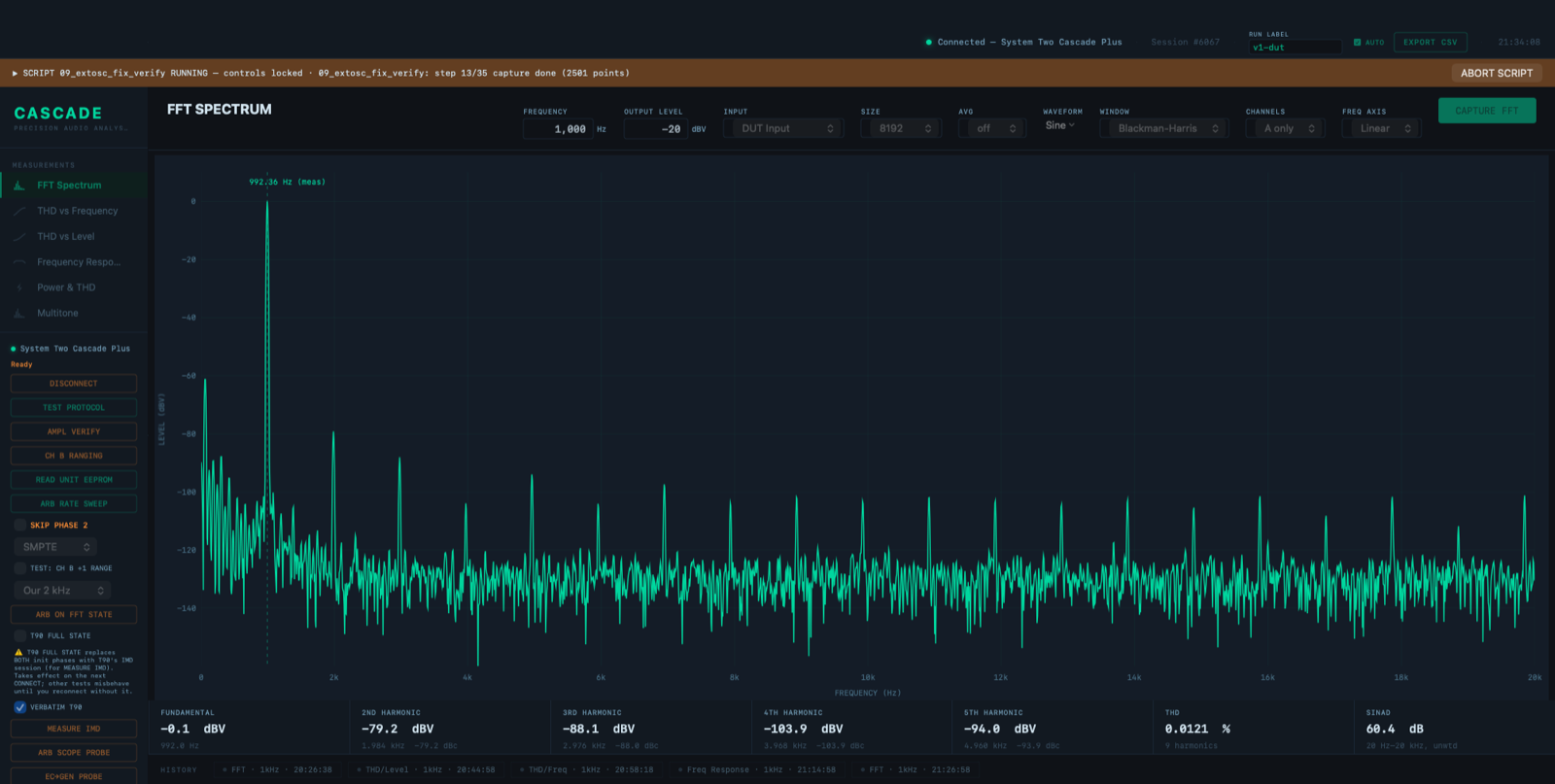
- 1 The fundamental: the oscillator at 992 Hz, −0.1 dBV
- 2 2nd harmonic, about 79 dB below the fundamental
- 3 THD from the harmonics that stand clear of the floor (9 here)
Status. Hardware-verified: −20.02 dBV against APWIN's −19.99, and stereo channels agree to 0.004 dB. Limits:
- It reads only to 20 kHz although the data runs to 32 768 Hz, so THD of tones above about 3 kHz is short of harmonics. A 5 kHz tone has only four inside 20 kHz.
- SINAD matches APWIN (to 0.047 dB) only at N = 8192 with the tone on a bin. At other sizes it is wrong.
- Fixed 2026-10-09 (app
44861fe): the readouts now describe the channel that carries the tone (the tile says "FUNDAMENTAL · CH B" when it is B), and the crosshair snaps to peaks on every trace. Chris confirmed the snap on hardware. - An intermittent bad setup replay can make every capture time out until the next replay. Cause found 2026-10-10 (a refused DSP write); a patch is in, its effect still being measured.