Session story · 2026-10-24
Twelve decibels were hiding in the meter's own range
Session: 2026-10-22 05:25 → 2026-10-24 10:05 UTC (2026-10-21 22:25 → 2026-10-24 03:05 PDT; the evening of the 23rd into the small hours of the 24th) · the first real amplifier on the bench, a Scott 350R receiver: every Cascade tool checked against it, then APWIN's THD+N chased down to a tenth of a dB, IMD calibrated, and the output ground control Chris had asked for many times.
Where we started
The plan from the last session was a receiver test at unity gain. The receiver's volume control had other ideas. Chris: "so interestingly, i can not seem to find unity gain. closest i can get is to put 1V in and get .8V out. next step up is 1.36V out." Chris then pushed for more gain: "at .3W the signal to noise ratio will likely be quite low. maybe it is more useful to have the amplification up a bit. what do you think". The volume went up to a detent of about +19.2 dB (1 V in gave 9.0–9.3 V out), enough to reach the receiver's rated power from Cascade's +6 dBV limit.
The question
Do Cascade's measurements on a real, distorting device agree with APWIN's on the same device?
What happened
Every tool, on a real amplifier. The level reading matched Chris's handheld meter: "ok across cha my handheld reads 3.108V. CHA on cascade reads 3.1123 . CHB reads 2.83 on my meter and 2.83 on the app". STOP AT THD did not trip at 1 % up to about 48 W, and tripped at once at 0.01 %. Chris: "it did stop right away and noted it in the warning box". The FFT found real harmonics at last. Two small fixes went to the backlog, including no status line while THD vs Level loads its setup. APWIN then measured the same rig on the PC (T93).
Cascade read 12 dB too clean. Chris: "yes 2 first. let's investigate that discrepancy. it's possible we may need to run the test more than once, if this DUT is itself variable". APWIN's eight THD+N readings in T93 held the answer. The THD meter has its own autoranging gain stage, reported in a register Cascade never read. Each range step is 12 dB. On the loopback it always sat at range 1, so the bug had been invisible since June. Correcting for it moved Cascade from −80.3 to −73.6 dB, against APWIN's −75.8.
The last two decibels were one byte. Of every analyzer register, only two differed from APWIN's state. A probe tried both, five rounds, interleaved: the function meter's input byte did it (−73.56 → −75.70 dB, APWIN −75.8); the other did nothing. The old value had been labelled "HW-verified" in a comment. It had only ever been compared with a worse value, never with APWIN's.
Bad readings, three times blamed on the meter. Ch A then threw points at −46 and −50 dB in the middle of a smooth curve. Claude found two real reading bugs: Cascade sampled the meter without checking its reading counter, so a held value could pass as settled, and it read the range code after the result, so a range change between the two mislabelled a sample. Both were fixed the way APWIN reads. The bursts kept coming, and got worse as the receiver warmed. Chris asked a practical question: "how should i do this? with the power test? is this something you can automate?" That produced unattended scripts that run the probes. One of them ran the same probe with the receiver taken out of the loop: 90 points, none bad. The bursts were the receiver, warm and intermittent, exactly as Chris had warned. The control took six minutes. It should have come first.
A capture with someone else's packets in it. For IMD, Claude replayed APWIN's T93 session one mode at a time. Every mode came back with the same number, which is impossible. Chris: "keep monitoring it. it seems to be having trouble". The capture held 34 packets from another USB device on the PC, and the replay had sent them to the 2522. Chris quit Cascade and power-cycled the instrument. Every capture reader now keeps only the 2522's traffic; a sweep of all 118 captures found T93 the only one affected. Rebuilt, the probe passed in all five modes, three runs, each within 1.5× of APWIN and repeatable to 4 %.
The ground control, at last. The output configuration turned out to be one register for ground, and for unbalanced a rule: drive the balanced setting 6 dB higher, with one bit set. Cascade's own amplitude model reproduced APWIN's bytes exactly at three levels. On the Scott, the level held to 0.00 dB across configurations.
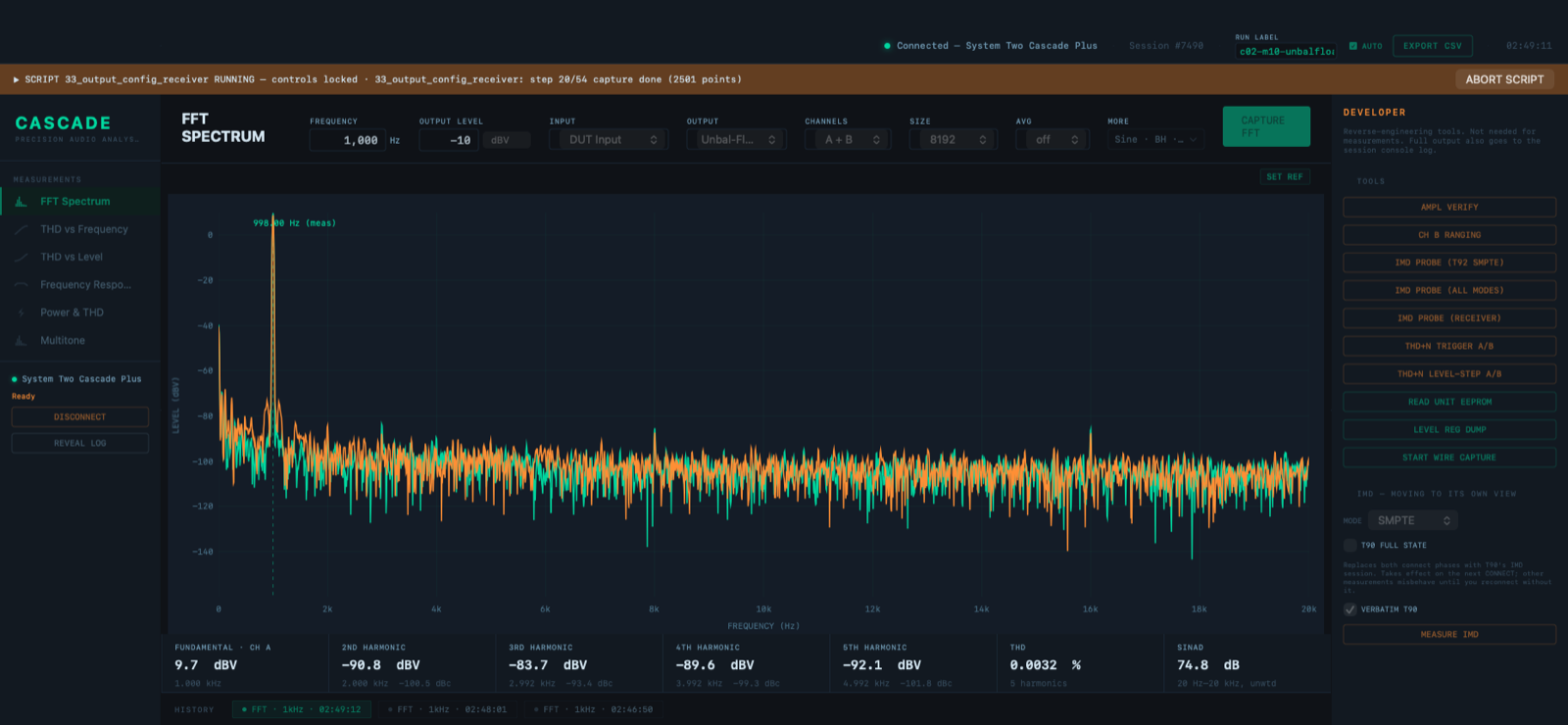
- 1 the new OUTPUT picker (Unbal-Float)
- 2 fundamental, the same in every configuration
- 3 the receiver's own harmonics
Bal-Gnd was the exception: through the RCA cable it shorts half the output, as APWIN's manual warns (−4.3 dB and four times the hum). The picker now says so.
The turns
- The THD meter has its own range; on the loopback it never moved, so a 12 dB error stayed hidden.
- A comment's "HW-verified" meant "gave a plausible number", not "matched APWIN".
- The bad points were the receiver, and only a run without it could say so.
- USBPcap records every device on the hub; a replay must send only the 2522's packets.
Beliefs that changed
| Before | After | What changed it |
|---|---|---|
| THD = residual ÷ fundamental | Plus the meter's own range, 12 dB a step | APWIN's eight T93 readings |
| Ch A FuncInput 0x10 was "HW-verified" | APWIN's 0x00; 0x10 reads 2 dB high and sticks | Five interleaved rounds |
| Stuck THD points were a meter fault | Two reading bugs, then a warm, crackling receiver | A loopback control, 90 clean points |
| A pcap holds the 2522's traffic | It holds every device on the hub | 34 foreign packets replayed |
| Unbalanced output needs its own calibration | Balanced + 6 dB, one bit | Byte-exact against APWIN at three levels |
What we learned about the instrument
- The THD function meter autoranges on its own, in 12 dB steps, reported in
EB 01 02. EB 01 0Dcounts the meter's readings; APWIN reads the result once per step.- IMD in APWIN is the meter's raw ratio divided by a per-mode factor (SMPTE about 5.3, DIM 30 about 0.7).
- Unbalanced output: the balanced setting for 6 dB more, with amplitude-code bit 2 set.
- Every connect briefly drives the generator to +6 dBV, with the outputs live — now the top backlog item.
What we learned about working together
- Plan the control without the DUT at the first anomaly. Chris said the receiver might be variable; one run without it would have settled three rounds of theories.
- "Verified" needs a reference. A value that gives a plausible number has not been compared with anything.
- Let the bench run itself. Chris's question about automating led to scripts that ran probes for an hour while nobody clicked.
Evidence
- Plan and results:
docs/bench_receiver_plan.md(parts 1, 3a, 3b and the THD+N table),docs/HANDBOOK.md§4. - Analysis:
docs/analysis/t93thd.py,t93imdfactor.py,t93config.py; buildersdocs/build_t93_imd_blob.py. - Scripts 30–33 in
docs/scripts/. App sessionssession_20261023-230431…session_20261024-024152. - Commits: app e47d579, bc92811, 64660bc, 78ceb39, cba7e8c; parent ef67908 … 7aad917.
Where we ended
THD+N, IMD and the output configuration all match APWIN on a real amplifier. Next is the connect-time +6 dBV burst. Chris: "ok taking a break. back tomorrow".